Last Updated: October 2026
The Guide to Effective Agile Retrospectives
If you’re tired of having retrospective meetings greeted with groans and heavy, reluctant sighs or feeling like you’re rehashing the same old problems with no signs of improvement, the advice Mark shares with you will help make your retrospectives more effective.
There’s no need to have retrospectives that people hate and aren’t even useful – with a few tweaks, you can have meetings your team will look forward to, and start seeing real improvements and results!
Includes follow-up support emails to reinforce what you learned and help you make real changes right away.

What Is an Agile Retrospective?
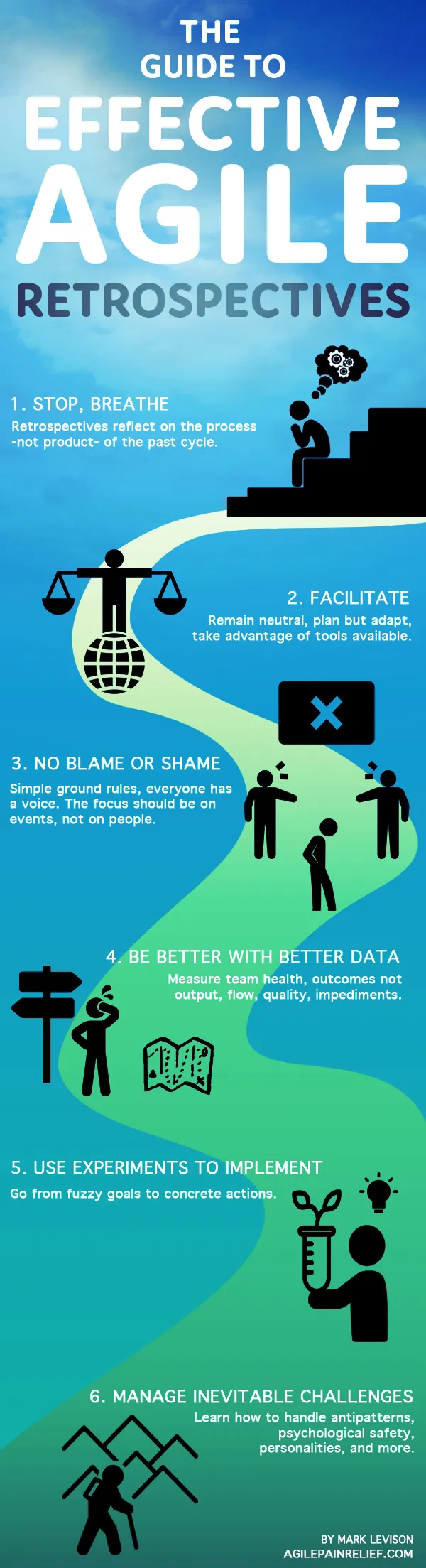
A retrospective is a structured moment for the team to stop, breathe, and reflect on the past cycle. The team meets to discuss what went well, what went less-than-great, and what could be better if the team has the energy to improve. In Scrum, the retrospective is usually the last activity in a Sprint.
Many teams struggle with retrospectives at first as they’re looking to score an early home run improvement. Later, they just want the activity to be over as fast as possible. “Just 3% better every Sprint” is what client Braden Box tells his teams they want to achieve. Curiously, if they do that consistently every two-week Sprint throughout a year, they will be more than twice as good at the end (1.03 ^ 24 == 2.03). In reality, teams will show remarkable improvement in some Sprints and not so much in others, however the power of small, compounding improvements is at the heart of what we’re looking for.
Why This Book?
Our world is changing at a faster rate than ever, and GenAI is speeding it up. Teams are asked to adopt new tools and new ways of working, often with little time to learn them. Scrum helps break change into manageable chunks and then gives us focus, with retrospectives as a critical tool for rapid adaptation. The retrospective is where a team asks what an AI tool actually changed in their work, what it made worse, and what to try next. It’s worth learning how to use them properly.
In The Guide to Effective Agile Retrospectives, Mark shares his secrets to creating retrospectives that don’t suck!
You’ll learn about:
- Common misunderstandings about retrospectives – let’s clear those up
- Recommended techniques and activities (Timeline, Story Oscars, Circle of Influence and more) to keep the meeting fun and engaging
- How to run retrospectives with distributed teams
- Why you need data for your retrospectives – what to gather, not gather, and what it can tell you
- Turning vague ideas like “We need to do better Unit Testing” into concrete experiments
- …and how to help these improvements actually happen
- Remedies for anti-patterns like: “All Talk, No Action”, “Perennial Problems”, and “ScrumMaster Hero”
Why this book? Because Mark was failing at Sprint Retrospectives before it was popular. After years of study and experimentation, his findings are now collected in this Guide so you don’t have to have to suffer the same pain.
Hint: This free eBook, and the accompanying email series, qualify for Scrum Alliance Education Units (SEUs).
Beyond SMART Goals: Using Experiments to Implement Improvements
Too many teams conduct their retrospective and agree on a fuzzy, general statement, like “We should write more Unit Tests” or “We should automate some tests,” without a common understanding of a) the goal, b) an action plan, and c) a way to measure success. These teams also tend to lack a way to visualize progress towards their goals, which makes sense because if you’re not clear on where you’re going, how do you know how far you’ve come? With all this vagueness, it isn’t surprising when they struggle to achieve anything beyond the most basic improvements that can be achieved by a single heroic team member.
It’s often assumed that all improvements will work – it says so right in their name, right? In fact, that’s unlikely. Instead, all “improvements” should be seen as experiments. Some experiments clearly improve the system, and you want to keep those. Some fail and you use those to seed the next experiment, which will be better calibrated to bring the results you hoped for. The trick is to view each experiment as an improvement in the process, which will ultimately bring you improvement on a larger scale. Use experiments to apply an improvement, that either succeeds or fails, so you can learn from that quickly and adjust accordingly.
Retrospective Anti-Patterns
Many retrospective anti-patterns occur because the team doesn’t have a fundamental understanding of retrospectives. They see them as a necessary evil, rather than the opportunity to reflect and improve.
All Talk, No Action
There are many reasons for this problem. Some teams just use retrospectives as casual discussion time, others create actions but they’re wishy-washy and ill-defined, some create actions but then never act on them, and others are too heads-down busy on Product Backlog Items to have time for that, or so it seems. In most of these cases, the challenge appears to be around creating and taking actions, and time pressure concerns.
Solution: Ensure that the retrospective has enough structure so that the team doesn’t stay stuck in discussion forever. Remember, some discussion is good, but not when it’s never-ending. Make time to refine improvements from fuzzy goals into concrete actions or experiments. Ask for volunteer experiment owners, track their progress through the Sprint, and ensure that you review the experiment outcomes with the team in the next retrospective. The time pressure is never going to go away, so we have to build in time specifically for making improvements during the Sprint, even if it’s only small increments.
Perennial Problems
In teams that take no action, or whose actions are ineffective, problems become permanent. It might seem like an issue has been resolved, but then it pops up again and again, like a bad weed. When that happens, we move from the mode of attempting to run experiments to the mode of “well, that’s just the way things are done around here.”
Solution: It’s best nipped in the bud before it becomes a bigger problem. If the team has already reached that stage, look for the smallest problem that the team could seek improvement on and improve there. The goal is to help the team regain its confidence or mojo with small wins.
ScrumMaster Hero
One of the few things most people “know” about Scrum, is that the ScrumMaster removes impediments. Therefore, they assume the ScrumMaster gets assigned all improvements. Or maybe a senior developer enjoys the heroic status of solving problems for the team. Since some people don’t enjoy improvement work, they’re happy to sit back and have someone else take the reins.
Solution: Contrary to popular belief, the ScrumMaster isn’t required to do all of the heavy lifting. Instead, they’re responsible for seeing that the problems get solved. Remind team members that when someone steps up, that means that they’re volunteering to shepherd the solution, not solve the problem themselves. If the person who does volunteer seems nervous, privately offer to coach them.
The full guide covers eight more anti-patterns, plus the challenges facilitators meet most often: the Dominator, the Non-Participator, and the team that doesn’t want retrospectives at all.
We've helped 8000+ people find success using Scrum
Proud to be the trusted training provider for many of the largest financial, insurance, software, and education organizations, as well as all levels of Canadian government.
Your Guide to Everything Scrum
Mark Levison spent 12 years as a ScrumMaster and Coach, helping teams by chance before he started to systemize it. Armed with an insatiable love for research, he has been studying and teaching Agile since 2001, introducing Scrum, Lean, and Agile methodology to a broad range of individuals and organizations. Mark has helped launch Scrum practice throughout Canada including Government of Canada departments, major financial and insurance institutions, healthcare agencies, and leading payroll, HR services, and software companies.
Students and communities benefit from Mark’s more than thirty years of experience in the IT industry and over two decades of Scrum and Agile expertise, as he brings his uniquely fun and effective teaching style to thousands of individuals and teams so they can be more effective.

Get Certified
Explore what Scrum is and how to make it work for you in our Scrum Certification training. Hands-on learning will guide you to improve teamwork, deliver quick feedback, and achieve better products and results.
Registration is now open for workshops:
About this course
Focuses on the role of the team and the ScrumMaster. Get the skills and practical experience necessary to improve teamwork, take the exam, and advance your career with a certification that is in high demand today. Often the best fit for anyone new to Scrum.
Learning and Benefits
Relatable Scenarios
Learn on-the-job applications of key Scrum concepts, skills, principles, along with practical solutions that you can apply the next day for difficult, real-life situations.
Respected Certification
Everything you need to earn your Scrum Alliance® ScrumMaster certification, including exam fee and membership, and so much more.
Practical Exercises
With focus on the challenges that real teams face, and tools to dig deeper. You don’t need more boring Scrum theory. You need something you can sink your teeth into to see immediate results.
Jargon-Free Learning
This workshop is not just for software development or people with a computer science degree. We’ve helped many non-software teams with Scrum.
Career Advancement
Use Scrum knowledge to standout at work, get paid more, and impress your customer, all without burning out.
GenAI for Systems Thinking
Learn the basics of using Generative AI as a tool to support Systems Thinking in your ScrumMaster role. Explore how to leverage GenAI to help uncover patterns, and think more deeply about the systems your team operates in.
Ongoing Support
Your learning doesn’t stop when the workshop ends. You get lifetime access to all course materials, plus a followup email series designed to reinforce your learning objectives and help you apply what you’ve learned on the job.